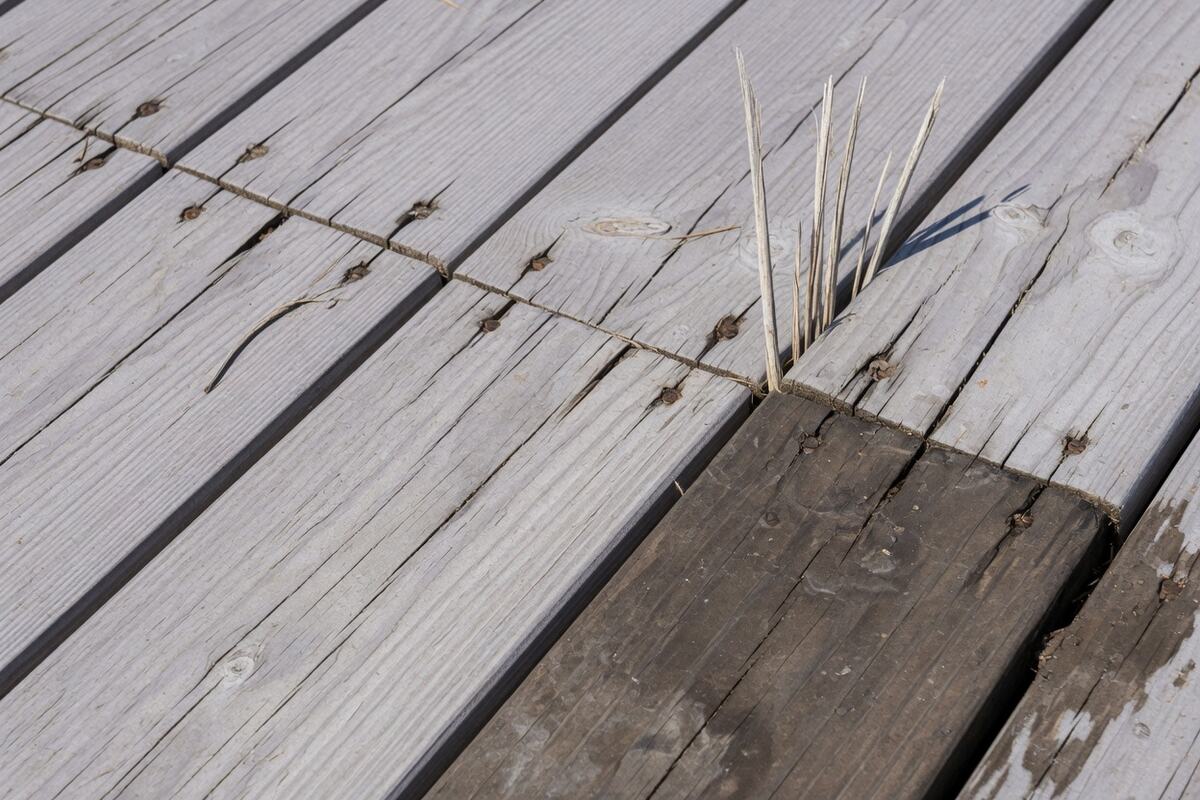
When new boards are the whole job
Walk it before you price it. A consistent slope away from the house is intentional drainage. Irregular dips are movement. Posts should be plumb. The railing should not travel when you push it. The ledger line, where the deck meets the house, should show no gap and no staining on the siding below. Probe the joists and the post bases with a screwdriver. Firm wood and a level frame means the surface can come off and a new one can go down on the same structure.
That job is tear-off, a look at the joist tops while they are bare, new boards, and disposal. You are not digging footings and you are not buying beams. It is a fraction of a new deck of the same size, which is why it is the right call when the structure has years left. The planning ranges on the cost page are for a whole deck, platform included. A board replacement leaves the footing line, the framing line, and usually the railing line alone. If a board-only quote starts to approach half the cost of a new deck, the frame is probably telling you something the first look missed.
When it is the wrong job
New boards on a deck that has heaved are a new surface on a twisting frame. The gap at the stairs comes back. The same is true of a soft ledger: the danger is the connection to the house, and covering it with fresh decking hides it. Springy spans mean the joists are undersized or rotting, and boards will not stiffen them.
The expensive local version is a footing that never reached 36 inches. It can lift in the first winters and rack the frame by the third spring. Boards are irrelevant to that repair. How to separate the four causes, in the order of what they cost.
Joist spacing, before you pick a product
An older wood deck in town is commonly framed at 16 inches on center. Pressure-treated or cedar boards will usually go back down on that spacing. Many composite and PVC products want 12 inches, and tighter again on stairs or on a diagonal layout. Finding that out after the material is in the driveway is how a simple re-deck becomes a framing project.
Sistering joists, or adding rows between them, is ordinary work and it is worth doing when the rest of the frame is good. It changes the price enough that it belongs in the quote before you compare composite to wood. Have the builder say, in the bid, what spacing the chosen product requires and whether this frame already has it. Which products hold up under the sun here, including the difference between a capped composite and PVC.
That is the one look you get at the tops of the joists, the ledger bolts, and the flashing. A builder who re-decks without talking about what they found under the old boards has skipped the useful half of the visit. Flashing that was never there can be added in the same opening. Waiting means pulling the new boards up later.
Permit, usually
Replacing the walking surface and leaving the structure alone generally does not require a building permit in Pocatello. The moment the work includes joists, beams, posts, footings, or the ledger, it generally does. The city's threshold, and the official pages.
Common questions
Can I replace the boards and leave the frame?
When the frame is sound, yes. Sound means the deck is level, the posts are plumb, the ledger is solid, and the tops of the joists are firm. Check the joist spacing against the new product before you buy it. Composite often wants 12 inches on center where an older wood deck was framed at 16.
Do I need a permit to replace deck boards in Pocatello?
Usually not, when the work is the surface boards and nothing structural moves. Replacing joists, beams, posts, footings, or the ledger is structural work, and a permit generally applies. If the whole deck is coming off, the replacement is a new deck.
Why did the boards fail while the frame is fine?
High-desert sun at this elevation checks, cups, and greys the surface long before the framing has a structural problem. The dry air is relatively kind to the lumber underneath, as long as water is not sitting in the usual places. A tired surface on a sound frame is the common case, and it is the case where new boards are the whole repair.
Is composite worth it when I am only replacing boards?
It can be. You are already pulling the old surface, so the refinishing cycle you are escaping is the one you would otherwise restart. The catch is joist spacing, and the condition of the joist tops, which you can see only with the old boards off. If the frame needs sistered joists to carry the product, price that before you compare the job to a new deck.